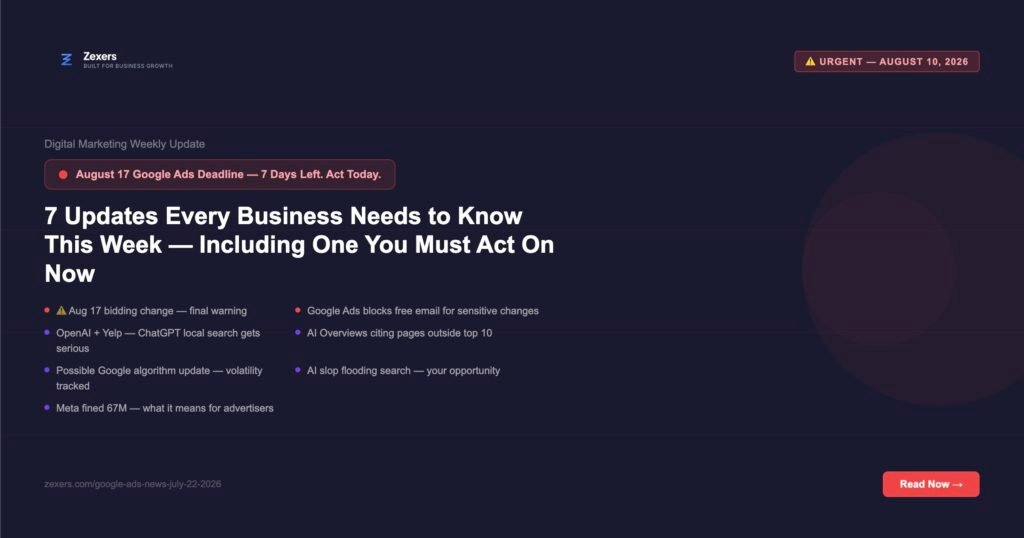
- ⚠️ August 17 is in 7 Days — Final Warning to Act Now
- OpenAI Partners With Yelp — ChatGPT Local Search Gets Serious
- Google Ads Blocks Free Email Accounts From Sensitive Changes
- Possible Google Algorithm Update — Volatility Being Tracked
- AI Overviews Now Citing Pages Outside the Top 10
- The AI Slop Problem — And Why It’s Your Opportunity
- Meta Fined $567M — What It Means for Advertisers
- What Every Business Should Do Right Now
- Frequently Asked Questions
The biggest week in Google Ads this year is upon us. The August 17 Smart Bidding change is now just 7 days away — and if you haven’t acted yet, today is the day. Beyond that urgent deadline, this week has also delivered significant updates from OpenAI, Google Search, and Meta that every business running digital marketing needs to understand.
Here’s everything that matters — with clear action steps for each update.
1. ⚠️ August 17 is in 7 Days — Final Warning to Act Now
We have covered this deadline in previous posts — but with 7 days remaining, this is the final warning. As of August 17, 2026, Google Ads is changing bidding behaviour for budget-limited campaigns. Here is exactly what is happening and what you need to do today.
Do this in your Google Ads account today — takes 15 minutes
What’s changing on August 17:
The main risk concerns campaigns whose target has become obsolete — a Target CPA set two years ago at €50 while the campaign has been converting at €30 for months. From August 17, Google will pull those campaigns back toward their stated target — meaning your cost per lead could rise from £30 to £50 without any change in budget.
Your 15-minute action plan — do this today:
- Log into Google Ads
- Go to Campaigns — filter for any showing “Limited by budget”
- For each limited campaign, note your actual CPA or ROAS over the last 30 days
- Compare to your stated Target CPA or ROAS
- If actual performance is better than your target — lower your target to match actual performance right now
- Use the Bid Target Adjustment Tool in your account to do this efficiently
Important clarifications from Google’s own Q&A on this update:
- This is not an auction change — Google Ads auction mechanics stay the same. Only the bidding behaviour evolves.
- No automatic extra spend — your daily and monthly caps are still respected. The update does not increase your spend by itself.
- Campaigns not limited by budget don’t change — they already optimise toward their target and will keep doing so.
- Google touches neither your targets nor your budgets — no automatic modification.
- Inaction is a choice — potentially a costly one.
2. OpenAI Partners With Yelp — ChatGPT Local Search Gets Serious
An official partnership between OpenAI and Yelp has been made, which means that the local search feature of ChatGPT has been strengthened considerably. This is one of the most significant local search developments of 2026.
ChatGPT can now recommend local businesses using Yelp’s real-time data
Until now, ChatGPT’s ability to recommend local businesses was limited — it had general knowledge but no access to real-time local business data like reviews, hours, availability, and ratings. The Yelp partnership changes this entirely.
Now when someone asks ChatGPT “find me a good accountant near me” or “best Google Ads agency in [city]” — ChatGPT can pull live Yelp data to give specific, accurate, up-to-date recommendations including reviews and business details.
What this means for local businesses:
- Your Yelp profile is now a direct input into ChatGPT recommendations
- Businesses with strong Yelp reviews and complete profiles are more likely to be recommended by ChatGPT
- A neglected or incomplete Yelp profile could mean being invisible in ChatGPT local search
- This adds Yelp to the list of platforms that directly affect your AI search visibility
What to do right now:
- Claim and complete your Yelp business profile if you haven’t already
- Ensure your business name, address, phone, hours, and services are accurate
- Start actively collecting Yelp reviews from satisfied clients — they now influence ChatGPT recommendations directly
- Respond to all existing Yelp reviews — positive and negative
3. Google Ads Blocks Free Email Accounts From Sensitive Changes
Google Ads is testing a new security feature to disallow free domain email addresses from performing sensitive actions on a Google Ads advertiser account. This affects anyone managing Google Ads with a Gmail, Hotmail, or other free email address.
What counts as a “sensitive action” in Google Ads
Sensitive actions in Google Ads include things like:
- Changing billing information or payment methods
- Adding or removing account administrators
- Transferring account ownership
- Accessing certain account-level settings
Google’s motivation is clear — free email accounts are easier to compromise through phishing and social engineering. Requiring a business domain email for sensitive changes significantly reduces the risk of account takeover.
What to do:
- Check which email address is the primary admin on your Google Ads account
- If it’s a Gmail or other free email — add your business domain email (name@yourbusiness.com) as an admin
- Make your business domain email the primary admin
- This is currently being tested — but it’s good practice regardless
4. Possible Google Algorithm Update — Volatility Being Tracked
Search Engine Watch is tracking a potential Google algorithm update in August 2026, reporting ongoing fluctuations and volatility in search engines. As of this week, nothing has been officially confirmed by Google — but SEO professionals are reporting significant ranking movement across multiple industries.
What to do when Google algorithm volatility is detected
Signs your site has been affected:
- Significant drop or increase in organic traffic over the last 7–14 days
- Rankings changing noticeably for your key target keywords
- Changes in which pages Google is indexing or featuring
What to do if you see unusual ranking movement:
- Check Google Search Console for any manual actions or coverage issues
- Compare your traffic week-on-week in Google Analytics — is the change sudden or gradual?
- Don’t make panic changes to your website — algorithm updates often settle within 2–3 weeks
- Focus on content quality — Google’s updates consistently reward helpful, specific, well-structured content
- Monitor the situation for 2 weeks before making any major SEO changes
Our take: Unconfirmed algorithm volatility is common and doesn’t always mean a major update is underway. Keep publishing quality content, monitor your Search Console, and avoid knee-jerk reactions.
5. AI Overviews Now Citing Pages Outside the Top 10
This is a significant shift in how SEO success should be measured. AI Overviews often cite pages outside the top 10 — so ranking alone is no longer the whole game.
Google’s AI is choosing citations based on content quality — not just position
For years, ranking in the top 10 was the primary goal of SEO. A page outside the top 10 was essentially invisible. AI Overviews have changed this — Google’s AI is selecting citation sources based on content quality, specificity, and trustworthiness — not purely on search ranking position.
This means a page ranking position 15 or 20 could be cited in an AI Overview and receive significant visibility — while a page ranking position 3 with thin content gets ignored entirely.
The best pages answer a narrow buyer question fast, then add evidence, examples, and clear decisions. Small businesses can win by focusing on comparison pages, pricing pages, and problem-solving pages tied to real purchase intent.
What to prioritise for AI Overview citations:
- Direct, specific answers — answer the question clearly in the first paragraph
- Real evidence and examples — data points, case studies, specific numbers
- Clear structure — H2 headings, bullet points, FAQ sections
- Purchase-intent pages — comparison pages, pricing pages, “X vs Y” posts
- Authorship signals — who wrote this and why should Google trust them?
6. The AI Slop Problem — And Why It’s Your Opportunity
AI slop is low-value content made wholly or substantially with generative AI and released with too little human judgment, verification, craft, or accountability. It is commonly produced because speed, scale, traffic, engagement, or cost reduction matters more to the publisher than usefulness to the person receiving it.
The internet is filling with AI slop — stand out by being genuinely useful
The volume of AI-generated content online has exploded in 2026. Every industry, every topic, every keyword now has dozens of AI-written articles that all say essentially the same thing in essentially the same way. Google and other AI systems are actively working to detect and demote this content.
August 2026 confirms a harder, cleaner version of SEO. Search rewards pages that are useful, structured, specific, and trustworthy.
How to make sure your content isn’t AI slop:
- Add specific real-world examples — “We ran this exact campaign for a plumber in Birmingham and generated 34 leads in 30 days at £18 CPL”
- Include your genuine opinion — agree or disagree with conventional wisdom based on your actual experience
- Use real data — reference actual numbers from your campaigns, your clients, your industry
- Edit ruthlessly — remove anything generic that could have been written by anyone about anything
- Add human voice — write how you actually speak, not how an AI thinks a professional sounds
AI tools are still valuable for drafting, structuring, and speeding up your writing process. But the final output must have genuine human expertise, real examples, and authentic voice — or it will increasingly be invisible in both Google Search and AI citations.
7. Meta Fined $567M — What It Means for Advertisers
A New Mexico judge ruled that Meta is a key contributor to a youth mental health crisis and fined the company $567 million for failing to protect teens. This is part of a growing wave of regulatory action against social media platforms.
What increasing Meta regulation means for your Facebook and Instagram ads
The fine itself doesn’t directly change how Facebook and Instagram ads work today. But the regulatory direction is clear — platforms targeting younger audiences are facing increasing scrutiny and restriction. For businesses advertising on Meta:
- Teen-targeted advertising restrictions are tightening — if your audience includes under-18s, review your targeting settings and ensure compliance with current Meta policies
- Data usage regulations are increasing — expect more restrictions on how Meta can use audience data for ad targeting over the coming 12–18 months
- Platform diversification matters more than ever — businesses that rely entirely on Meta ads are exposed to regulatory risk. Maintaining Google Ads alongside Meta ads reduces this risk
- First-party data becomes more valuable — your own email list and CRM data is unaffected by platform regulation and becomes more valuable as third-party targeting becomes more restricted
What Every Business Should Do Right Now
In order of urgency
- TODAY — August 17 bidding check
15 minutes in Google Ads. Filter for budget-limited campaigns. Lower targets to match actual performance. Do not wait until next week. - THIS WEEK — Claim and complete your Yelp profile
The OpenAI-Yelp partnership makes this a direct input into ChatGPT local search recommendations. Complete every field and start collecting reviews. - THIS WEEK — Check your Google Ads admin email
Ensure your account is managed from a business domain email, not a free Gmail account. Add your business email as admin if needed. - THIS WEEK — Monitor your organic rankings
Check Search Console for any unusual traffic or ranking changes related to the possible algorithm update. Don’t panic — just monitor. - ONGOING — Review your content for AI slop
Read your recent blog posts honestly. Does anything read as generic, interchangeable, or obviously AI-generated without human expertise added? Rewrite those sections. - ONGOING — Build your email list
With Meta regulation tightening, your own email list is your most valuable owned marketing asset. Every piece of content should have an email capture opportunity.
Not Sure If Your Campaigns Are Ready for August 17?
Book a free strategy call with Zexers. We’ll check your budget-limited campaigns before the deadline, review your Yelp and local search presence, and make sure your content strategy is built for AI citation — not invisibility.
Book My Free Strategy CallFree call. No commitment. Response within 1 business day.