- Why Choosing the Right Agency is One of the Most Important Business Decisions You’ll Make
- Question 1 — Will My Campaigns Run in My Own Account?
- Question 2 — How Do You Define and Measure Success?
- Question 3 — Have You Worked in My Industry Before?
- Question 4 — Who Specifically Will Manage My Account?
- Question 5 — What Does Your Onboarding Process Look Like?
- Question 6 — What Results Can I Realistically Expect and When?
- Question 7 — How Do You Handle It When Campaigns Aren’t Working?
- Question 8 — What Does Your Reporting Look Like?
- Question 9 — What Are Your Contract Terms and Exit Conditions?
- Question 10 — Can I Speak to One of Your Current Clients?
- Red Flags to Watch For
- Frequently Asked Questions
Hiring a marketing agency is one of the highest-stakes decisions a business owner makes. Get it right and you gain a partner that generates consistent leads, grows your revenue, and frees you to focus on delivering for clients. Get it wrong and you’re months down the line, thousands of dollars poorer, and back to square one.
The frustrating truth is that most agencies look identical on the surface. Professional websites, impressive case studies, confident proposals, and a sales rep who knows exactly what you want to hear. Telling the difference between a genuinely good agency and one that will disappoint you is hard — unless you know the right questions to ask.
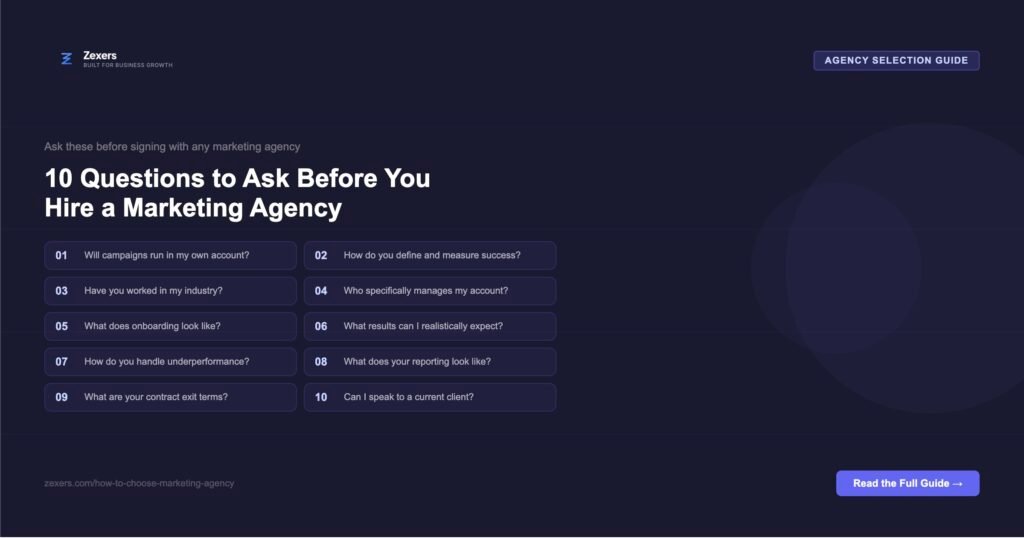
These 10 questions are the ones we wish every business would ask before signing with any agency — including us. The answers will reveal more about an agency’s real capabilities, values, and track record than any proposal or pitch deck ever could.
Why Choosing the Right Agency is One of the Most Important Business Decisions You’ll Make
A good agency relationship compounds over time. The longer a great agency works with your business, the more they understand your clients, your market, and what works for you — and the better your results get month after month. A bad agency relationship does the opposite — it drains budget, wastes time, and leaves you worse off than when you started because you’ve lost months you could have spent building something that works.
What’s actually at risk when you choose the wrong agency
- Wasted ad spend — a poorly managed Google Ads account can burn through thousands of dollars generating zero qualified leads
- Lost time — the months spent with a bad agency are months your competitors were building momentum
- Data loss — if campaigns run in the agency’s account rather than yours, you lose all historical data when you leave
- Damaged trust — a bad experience makes it harder to invest in marketing again even when the right partner comes along
- Opportunity cost — every month with the wrong agency is a month you weren’t generating the leads you needed to grow
The 10 questions below are your protection against all of these outcomes.
Question 1 — Will My Campaigns Run in My Own Account?
This is non-negotiable — your data must belong to you
Ask every agency: “Will my Google Ads campaigns run in my own Google Ads account, with you having manager access?” The correct answer is yes — always.
Some agencies run client campaigns inside their own master account. This gives them more control and makes it harder for clients to leave — but it means all your campaign history, conversion data, audience lists, and the machine learning your campaigns have accumulated belong to the agency, not you. When you leave, you start from zero.
What the right answer looks like: “Yes, your campaigns will run in your own Google Ads account. We’ll request manager access, which you can revoke at any time. All data, campaigns, and creative assets belong to you permanently.”
What should concern you: Any hesitation, vague language about “our systems,” or suggestion that running in their account is “standard practice” or “more efficient.” It is not standard practice at reputable agencies.
Question 2 — How Do You Define and Measure Success?
The answer reveals everything about what the agency actually optimises toward
Ask: “What metrics will you use to measure whether our campaigns are successful — and how do those connect to actual leads and revenue for my business?”
A genuinely performance-focused agency will immediately talk about leads, cost per lead, and revenue. An agency that leads with impressions, reach, click-through rates, or Quality Score without connecting them to business outcomes is telling you what they actually optimise toward — and it’s not your results.
What the right answer looks like: “Our primary success metrics are number of leads generated, cost per lead, and lead-to-client conversion rate. We track these every week and our optimisation decisions are driven by improving them. We also track revenue attributable to campaigns where your sales data allows.”
What should concern you: Extensive focus on vanity metrics — impressions, reach, engagement, Quality Score — without a clear bridge to leads and revenue. These metrics can look impressive while your business generates zero new clients.
Question 3 — Have You Worked in My Industry Before?
Industry experience shortens the learning curve — sometimes by months
Ask: “Have you worked with businesses in my specific industry? What are the unique challenges my industry faces in paid advertising and SEO, and how does your approach account for them?”
The second part of that question is the important one. Any agency can say yes to the first part. The second part tests whether their experience is real — because the challenges differ significantly by industry. Legal advertising has specific compliance requirements. Medical practices face strict Google Ads policies. Home services compete differently from B2B SaaS. An agency with genuine experience in your industry will answer the second question without hesitation.
What the right answer looks like: Specific, detailed knowledge of your industry’s challenges — not a generic overview. “In your industry we typically see X challenge with Y keyword, which we address by doing Z. We’ve found that A converts better than B for your type of client.”
What should concern you: A generic answer that could apply to any industry. If they can’t name specific challenges your industry faces without Googling it, their experience is likely shallow.
Question 4 — Who Specifically Will Manage My Account?
The person who sells you the agency is rarely the person who manages your account
Ask: “Who specifically will be managing my account day-to-day? Can I meet them before I sign? What is their experience level and how many other accounts do they manage?”
This is one of the most revealing questions you can ask. At many agencies, the senior people who pitch new business hand accounts off to junior staff after signing. The person you were impressed by in the sales meeting never touches your account again.
What the right answer looks like: They introduce you to your actual account manager before you sign. That person has verifiable experience, can speak knowledgeably about your specific situation, and manages a reasonable number of accounts — not 50 clients simultaneously.
What should concern you: Vague answers about “a dedicated team,” inability or unwillingness to identify who specifically will manage your account, or an account manager who seems unfamiliar with your industry or business when you meet them.
Question 5 — What Does Your Onboarding Process Look Like?
A good onboarding process tells you how seriously an agency takes understanding your business
Ask: “Walk me through exactly what happens in the first 30 days after I sign with you. What information do you need from me and what will you deliver?”
The onboarding process reveals how much genuine discovery an agency does before spending your money. A great agency has a structured onboarding that includes deep questions about your business, your ideal clients, your competitive landscape, your sales process, and your goals. A mediocre agency will ask for your logo and credit card details and start running ads within days.
What the right answer looks like: A clear, structured 30-day onboarding including: discovery call to understand your business and clients, competitor research, campaign strategy document, tracking setup and verification, landing page review, and a first campaign launch with clear initial targets.
What should concern you: “We’ll have your campaigns live within 48 hours.” Speed is not a virtue in campaign setup. Proper setup takes time because proper setup requires understanding your business first.
Question 6 — What Results Can I Realistically Expect and When?
The honest answer to this question separates genuine experts from salespeople
Ask: “Based on what you know about my business and budget so far, what results can I realistically expect at 30 days, 90 days, and 6 months? And what are the main factors that could affect those results?”
This question is a truth test. An honest agency gives you realistic, nuanced expectations based on your specific situation — including the factors that could cause things to take longer or cost more than expected. An agency trying to close the deal tells you what you want to hear.
What the right answer looks like: Specific, honest estimates with clear caveats. “With your budget targeting your local area, we’d expect to start generating leads within 2–4 weeks. At 90 days we should have enough data to identify your best-performing keywords and optimise cost per lead. By month 6, campaigns should be significantly more efficient than month 1. The main factors that could affect this are landing page conversion rate and how competitive your specific target area is.”
What should concern you: Guaranteed results, promises of specific lead volumes before any research has been done, or unrealistically positive timelines designed to get you to sign quickly.
Question 7 — How Do You Handle It When Campaigns Aren’t Working?
Every campaign hits challenges — what matters is how an agency responds
Ask: “If after 60 days my campaigns aren’t generating the results we expected, what specifically would you do? How would you communicate that to me and what would the next steps be?”
This question reveals an agency’s honesty, problem-solving capability, and communication values. Every campaign hits periods of underperformance. The difference between a great agency and a mediocre one is whether they tell you proactively and have a clear plan — or go quiet and hope things improve on their own.
What the right answer looks like: “We’d reach out to you proactively as soon as we identified the problem — we wouldn’t wait for you to ask. We’d bring you a clear diagnosis of what’s not working, specific proposed changes, and realistic revised expectations. If the issue is something outside our control like a landing page conversion problem, we’d flag that and work with you to fix it.”
What should concern you: Vague answers about “optimising” and “giving it more time.” An agency that can’t articulate a clear process for handling underperformance doesn’t have one — and will default to silence when things go wrong.
Question 8 — What Does Your Reporting Look Like?
Ask to see a real report from a current client — not a template
Ask: “Can you show me an example of the monthly report a client in a similar situation to mine receives? And will we have a call to review it each month or just an email?”
A report tells you exactly what an agency thinks success looks like. If their sample report leads with impressions and reach — that’s what they optimise toward. If it leads with leads generated and cost per lead — that’s a performance agency.
What the right answer looks like: A clear, readable report that leads with business outcomes — leads generated, cost per lead, revenue attributable — followed by the campaign data that explains those outcomes. Plus a monthly call where someone walks you through the numbers and explains what they mean in plain language.
What should concern you: A PDF full of graphs that look impressive but don’t include lead volume or cost per lead as headline metrics. Or a report that’s emailed with no accompanying call — because a report you can’t ask questions about is just a document.
Question 9 — What Are Your Contract Terms and Exit Conditions?
The contract terms reveal how confident an agency really is in their results
Ask: “What are your minimum contract terms? What happens if I want to leave before the contract ends? What notice period is required?”
An agency that’s genuinely confident in their results doesn’t need to lock you in for 12 months. Long lock-in contracts protect the agency — not you. The best agencies operate on 30–90 day notice periods because they’re confident you’ll stay based on results, not because of contractual obligation.
What the right answer looks like: A reasonable minimum initial period (1–3 months to get campaigns set up and generating data) followed by a 30–60 day rolling notice period. Clear confirmation that all your campaign data, creative assets, and account access remain yours if you leave.
What should concern you: 12-month minimum contracts with significant exit penalties, vague language about data ownership upon termination, or any suggestion that your campaigns or data would be inaccessible if you left.
Question 10 — Can I Speak to One of Your Current Clients?
Real client references are the most reliable signal of an agency’s true performance
Ask: “Can you provide me with the contact details of 2–3 current clients I can speak to directly — ideally in a similar industry to mine?”
This is the most revealing question of all — not because of what current clients say, but because of whether the agency provides them willingly. An agency with genuinely happy clients will offer references without hesitation. An agency that deflects, provides only written testimonials, or offers to “arrange an introduction” rather than giving you direct contact details is protecting itself from honest client feedback.
What to ask current clients:
- Are the results they promised matching the results you’re actually getting?
- How quickly do they respond when you have a problem or question?
- Have there been any surprises — positive or negative — since you started working with them?
- Would you recommend them to a business similar to yours?
- Is there anything you wish you’d known before signing with them?
What should concern you: Reluctance to provide direct client references, only offering written case studies or video testimonials, or clients who seem coached in what to say rather than genuinely enthusiastic.
Red Flags to Watch For
8 red flags that should make you walk away
- Guaranteed results — no legitimate agency guarantees specific lead volumes or rankings. Anyone who does is either lying or will find a way to technically deliver while missing the point entirely.
- Proposal in 24 hours — a proposal produced within 24 hours of your first call is a template, not a strategy. Real strategy requires real understanding of your business first.
- Pressure to sign quickly — “this pricing is only available until Friday” or “we only have one slot left” are sales tactics, not reasons to make a significant business decision quickly.
- No questions about your business — if an agency is more interested in telling you about themselves than understanding your business, clients, and goals — they’re selling a product, not a partnership.
- Campaigns in their account — as covered in Question 1, this is a deal-breaker. Walk away.
- Vague on who manages your account — if they won’t tell you who specifically will work on your campaigns, assume it’s the most junior person available.
- No case studies with real numbers — “we helped a client grow their business” without specific metrics is meaningless. Real results come with real numbers.
- 12-month minimum contracts — confidence in results means short notice periods. Long lock-ins protect the agency, not you.
Looking for an Agency That Can Answer All 10 of These Questions Confidently?
Book a free strategy call with Zexers. We’ll answer every one of these questions honestly, show you real client results with real numbers, and give you a clear picture of what we could achieve for your specific business — no pressure, no lock-in pitch, no fluff.
Book My Free Strategy CallFree call. No commitment. No hard sell. Just honest answers.