If you run a website, run Google Ads, or care about where your business shows up online — the last two weeks have been the most important in digital marketing in years. Google just dropped its biggest update of 2026, held its annual Marketing Live event packed with AI announcements, and ChatGPT launched self-serve ads. All at the same time.
Here’s everything that happened, what it means for your business, and exactly what to do about it.
1. What Just Happened — Google May 2026 Core Update
Google rolled out its May 2026 Core Update — and it’s being called the biggest search update of the year. But unlike previous updates that simply reshuffled rankings, this one changed something more fundamental: how Google decides what content to show and where.
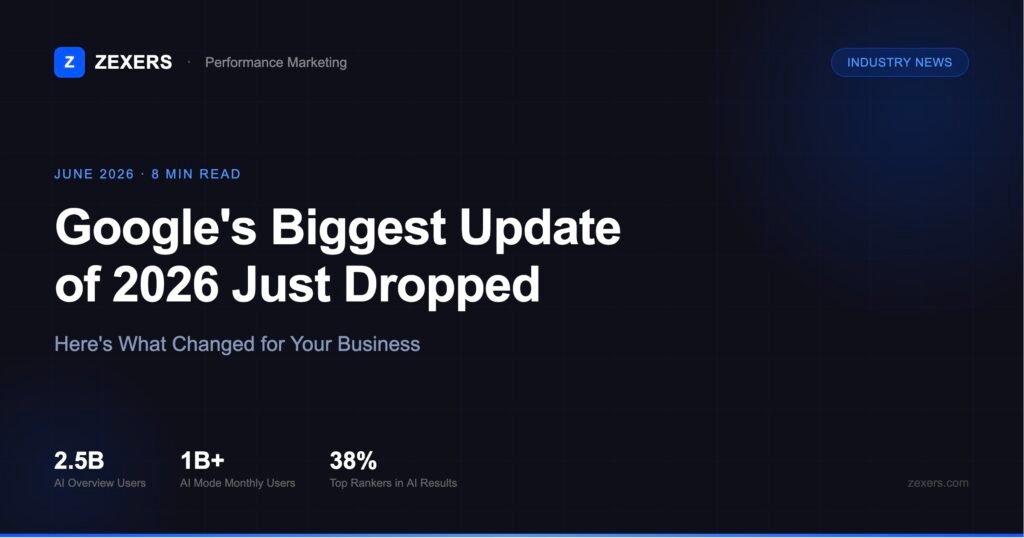
The update ran in parallel with Google I/O, where Google announced that AI Mode — the new AI-powered search experience — has now crossed 1 billion monthly active users. AI Overviews, the summaries Google shows at the top of search results, are now reaching 2.5 billion users globally.
This means your SEO strategy in 2026 needs to work on three levels simultaneously:
- Traditional ranking — appearing in the regular blue link results
- AI Overview citation — being cited as a source in Google’s AI summaries
- AI Mode visibility — appearing in Google’s conversational AI search results
2. AI Overviews Are Changing Who Gets Traffic
Here’s the number that should get every business owner’s attention: in mid-2025, the top 10 Google results accounted for 76% of AI Overview citations. By early 2026, that share had dropped to just 38%. Google’s AI is now pulling from a much wider range of sources — not just the top ranked pages.
This is actually good news for smaller businesses and newer websites. You no longer need to be ranked #1 to get cited in AI Overviews — but you do need to write content in a specific way.
What Google’s AI looks for when choosing sources to cite
Google has now published official guidance on how AI search selects content. The key factors are:
- Passage structure — content broken into clear, direct, answerable sections
- Information consistency — the same facts appearing consistently across multiple sources
- Direct answers — content that answers questions clearly without burying the answer
- Clean formatting — proper headings, short paragraphs, bullet points
- Content available to AI crawlers — no blocks on Googlebot or AI crawlers
Backlink count — the old gold standard of SEO — now matters significantly less for AI citation than content structure and clarity.
3. Google Marketing Live 2026 — What’s New for Ads
Google Marketing Live is Google’s annual event where they announce everything new in Google Ads. This year’s event was dominated by one theme: AI everywhere. Here are the biggest announcements and what they mean for your campaigns.
AI Max Campaign Type
Google announced AI Max — a new campaign type that uses AI to automatically expand your keyword targeting, rewrite your ad copy, and select the best landing page from your site — all in real time based on each individual search query.
What this means for you: More automation, potentially more reach — but also less control. Businesses with strong landing pages and clear conversion tracking will benefit most. Those without proper tracking will hand Google a blank cheque.
Display Ads Move to Demand Gen
Google Display Ads now has a new home inside Demand Gen campaigns. This isn’t just a cosmetic change — it signals that Google is pushing advertisers toward AI-driven, cross-channel campaigns rather than manually managed display placements.
What this means for you: If you currently run Display campaigns, you’ll need to migrate to Demand Gen. The good news is Demand Gen includes YouTube, Gmail, and Discover placements in one campaign — more reach for the same budget.
AI-Powered Creative with Asset Studio
Google launched Asset Studio — a tool that uses AI to generate ad images, headlines, and descriptions directly inside Google Ads. You provide your brand guidelines and it creates ad creative automatically.
What this means for you: Faster ad creation, more variations to test. But Google’s own guidance recommends a testing phase before relying on AI creative — human oversight still matters for brand consistency and quality.
Smart Bidding & Budget Updates
Google announced new Smart Bidding improvements and budget allocation tools — giving advertisers more control over how AI manages spend across campaigns. The new tools allow you to set guardrails on AI decisions while still benefiting from automated optimisation.
What this means for you: Smart bidding is getting smarter — but it still needs conversion data to perform. If you don’t have conversion tracking set up, these improvements won’t help you at all.
4. ChatGPT Now Runs Ads — What This Means
In a move that would have seemed impossible a year ago — ChatGPT has launched self-serve advertising. Ads are now available with no minimum spend, making it accessible to businesses of any size.
The platform rewards intent-matched, specific offers over generic brand messaging. ChatGPT users are in a conversational, research mindset — so ads that match the context of the conversation perform significantly better than standard banner-style ads.
For most businesses, ChatGPT Ads are worth a small test — but Google Ads remains the highest-intent, most measurable paid channel for lead generation in 2026.
5. What Every Business Should Do Right Now
5 things to do this week based on these updates
- Audit your content structure — reformat your key pages and blog posts with clear H2 headings, short paragraphs, and direct answers. This improves both traditional rankings and AI Overview citations.
- Check your Google Ads conversion tracking — with more AI automation in Google Ads, accurate conversion data is more critical than ever. Without it, AI bidding optimises for the wrong thing.
- Review your Display campaigns — if you run Google Display, start planning your migration to Demand Gen before Google forces the transition.
- Don’t panic about AI search — businesses with well-structured, helpful content are actually benefiting from these changes. Focus on writing clear, direct, useful content and you’ll be fine.
- Hold off on ChatGPT Ads for now — unless you have budget to experiment. Google Ads still delivers the best ROI for most service businesses in 2026.
Not Sure How These Changes Affect Your Business?
Book a free strategy call with Zexers. We’ll review your current Google Ads and SEO setup, identify what needs updating based on these changes, and give you a clear action plan.
Book My Free Strategy CallFree call. No commitment. Response within 1 business day.