- What a Lead Generation System Actually Is
- Step 1 — Build Your Traffic Engine
- Step 2 — Create a High-Converting Landing Page
- Step 3 — Capture Every Lead Automatically
- Step 4 — Build an Instant Follow-Up Sequence
- Step 5 — Nurture Leads That Aren’t Ready Yet
- Step 6 — Retarget Visitors Who Didn’t Enquire
- Step 7 — Track Everything and Optimise Monthly
- Your 90-Day Build Timeline
- Frequently Asked Questions
Most businesses don’t have a lead generation system. They have a collection of disconnected marketing activities — a Google Ad here, a social media post there, a website that sometimes gets traffic — with no clear path connecting any of it to a predictable flow of new clients.
A lead generation system is different. It’s a connected, automated sequence that takes a complete stranger from first discovering your business to becoming a qualified lead — consistently, predictably, and without requiring your personal involvement at every step.
The businesses generating the most leads in 2026 aren’t necessarily spending the most on marketing. They’re the ones who have connected all the pieces into a system that runs 24 hours a day, 7 days a week — whether they’re working, sleeping, or on holiday.
Here’s how to build one.
What a Lead Generation System Actually Is
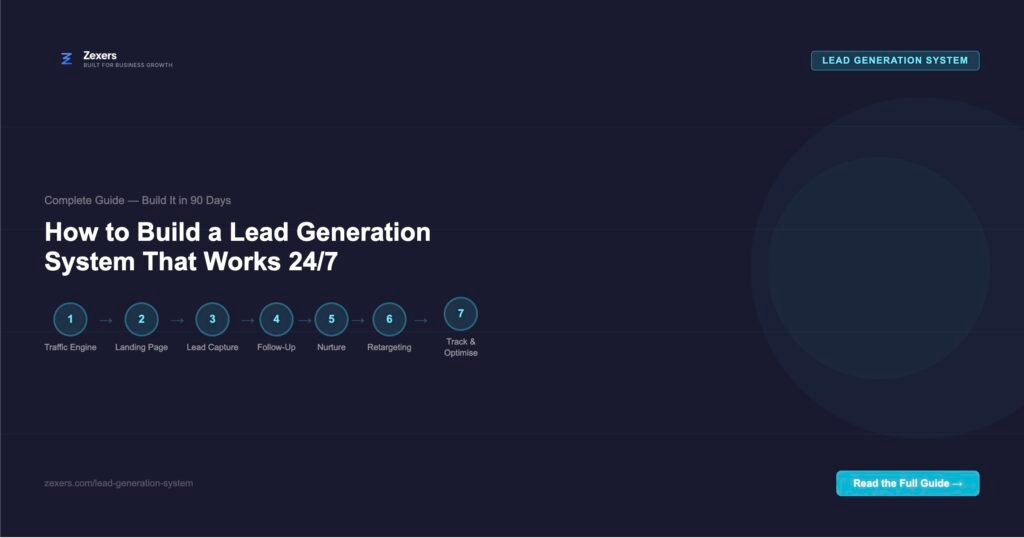
Think of a lead generation system as a pipeline with seven connected stages. Every person who becomes a client has moved through all seven — whether you consciously built the pipeline or not. The difference is whether they moved through it by accident or by design.
Every lead generation system has these components
- Traffic — people find out your business exists
- Landing page — they land somewhere that makes them want to take action
- Lead capture — they submit their details and become a lead
- Instant follow-up — they hear from you immediately
- Lead nurture — you build trust with leads not yet ready to buy
- Retargeting — you re-engage people who visited but didn’t enquire
- Tracking — you measure everything and improve monthly
Most businesses have 2 or 3 of these in place. A properly built system has all 7 — connected and automated.
Step 1 — Build Your Traffic Engine
You need at least two traffic sources — one paid, one organic
Relying on a single traffic source is the most fragile thing a business can do. If Google changes its algorithm, if your ad account gets suspended, if a platform changes its rules — a business with only one traffic source can go from busy to empty overnight.
A resilient traffic engine has at minimum:
- One paid source — Google Ads for immediate, intent-driven traffic. This is your tap you can turn on and off. Produces leads immediately but stops when you stop paying.
- One organic source — SEO and blog content for free, compounding traffic. Takes 3–6 months to build but generates leads indefinitely without ongoing spend.
Together these create a system where paid ads generate leads immediately while organic traffic builds in the background — and over time organic traffic reduces your dependence on paid spend.
For most service businesses the priority order is:
- Google Ads — for immediate lead flow while organic builds
- Google Business Profile — free local visibility, often generates leads within days
- Blog content — compounds over 12–24 months into significant free traffic
- Social media — supporting channel for brand awareness and retargeting
Step 2 — Create a High-Converting Landing Page
Traffic without a converting landing page is money down the drain
This is the most commonly skipped step — and the most expensive mistake. Businesses spend hundreds or thousands on Google Ads sending traffic to their homepage, which was never designed to convert paid visitors into leads.
A landing page built for lead generation is fundamentally different from a website homepage:
- No navigation menu — removes the ability to wander off
- One single goal — fill in the form, call the number, or book the appointment
- Headline matches the ad — message match is critical for Quality Score and conversions
- Above-the-fold CTA — your call to action is visible without scrolling
- Social proof — reviews, client logos, results with real numbers
- Fast load speed — under 2.5 seconds on mobile
- One landing page per campaign — not one page for all traffic
A landing page with a 10% conversion rate generates 5x more leads than one converting at 2% — from exactly the same traffic and exactly the same ad spend. Improving your landing page is the highest-ROI activity in your entire lead generation system.
Step 3 — Capture Every Lead Automatically
Every visitor who shows intent should become a lead — automatically
Lead capture is about making it as easy as possible for an interested visitor to give you their contact details — and making sure that when they do, their information flows automatically to wherever you need it without manual intervention.
Lead capture mechanisms to have in place:
- Contact form — simple, maximum 4 fields. Name, email, phone, and one qualifying question
- Google Lead Form assets — now available to all advertisers, lets people enquire without leaving Google
- Click-to-call — phone number clickable on mobile, tracked with call tracking software
- Live chat or WhatsApp — for visitors who want to ask a quick question before committing
- Calendar booking — Calendly or similar, lets people book a call directly without back-and-forth emails
Automation to set up:
- All form submissions flow automatically to your CRM or email inbox
- Every lead triggers an instant SMS notification to your phone
- Every lead triggers an instant auto-reply email confirming receipt
- All leads are tagged by source — Google Ads, organic, referral — so you know what’s working
Step 4 — Build an Instant Follow-Up Sequence
Speed of follow-up is the single biggest factor in converting leads to clients
The data on this is unambiguous: businesses that respond to a lead within 5 minutes are 21 times more likely to convert them than businesses that respond after 30 minutes. Most businesses respond hours or days later — and wonder why their leads go cold.
Your instant follow-up sequence should look like this:
- Immediately (0 minutes) — auto-reply email sent to the lead confirming you received their enquiry and setting expectations (“We’ll be in touch within 2 hours during business hours”)
- Immediately (0 minutes) — SMS notification sent to your phone or sales team with the lead’s details
- Within 5 minutes (business hours) — personal call or WhatsApp message from a real person
- Same day (if no answer) — follow-up email with more information about your service
- Day 2 (if still no response) — second follow-up with a specific offer or invitation to book a call
- Day 5 (final follow-up) — last attempt, low pressure, leave the door open
This 6-step sequence can be mostly automated using any email marketing tool — and it ensures no lead is ever lost due to slow follow-up.
Step 5 — Nurture Leads That Aren’t Ready Yet
Most leads aren’t ready to buy immediately — but they will be eventually
Research consistently shows that only 3% of your potential market is actively ready to buy right now. Another 17% are open to it. The remaining 80% are not ready yet — but they will be at some point. Most businesses only market to the 3% and ignore the other 97%.
A lead nurture sequence keeps you top of mind with the 97% until they’re ready. It’s how small businesses punch above their weight against larger competitors with bigger budgets.
Simple lead nurture system that works:
- Monthly email newsletter — one useful tip, one recent client result, one CTA. Takes 30 minutes to write. Keeps your name in front of every lead who isn’t ready yet.
- Blog content — every new blog post sent to your email list. Builds expertise over time.
- Case studies — when you get a great client result, send it to your entire lead list. “We just helped a law firm generate 47 leads in 30 days” is powerful nurture content.
- Seasonal offers — end of financial year, January fresh start, industry-specific busy seasons. Time-sensitive offers convert fence-sitters.
Step 6 — Retarget Visitors Who Didn’t Enquire
97% of your website visitors leave without enquiring — retargeting brings them back
Retargeting ads follow your website visitors around the internet after they leave — showing them your ads on Google, YouTube, Facebook, and Instagram. These ads typically cost a fraction of standard ads and convert at significantly higher rates because the audience already knows who you are.
How to set up retargeting:
- Google Ads retargeting — add the Google Ads remarketing tag to your website. Create a campaign targeting people who visited your site but didn’t fill in the form.
- Facebook/Instagram retargeting — install the Meta Pixel on your website. Create a custom audience of website visitors and show them ads on Facebook and Instagram.
- YouTube retargeting — show video ads to people who visited your website. Highly effective for building brand familiarity at low cost.
Retargeting ad message: Don’t repeat your original ad. Address the hesitation. “Still thinking about it? Here’s what our clients say” or “Get answers to your questions in a free 20-minute call” tend to work well for retargeting.
Step 7 — Track Everything and Optimise Monthly
A system you don’t measure is a system you can’t improve
The final piece of a lead generation system is the measurement layer that tells you what’s working, what isn’t, and where to focus your improvement effort next month.
Monthly metrics to track:
- Total leads generated — by source (Google Ads, organic, referral, social)
- Cost per lead — for each paid channel
- Landing page conversion rate — visitors to leads percentage
- Lead to client conversion rate — what percentage of leads become paying clients
- Revenue attributed to marketing — total value of clients acquired through the system
- Return on ad spend — for every £1 spent on ads, how much revenue came back
Monthly optimisation routine (takes 60 minutes):
- Review last month’s numbers against targets
- Identify the biggest gap — is it traffic, conversion rate, or follow-up speed?
- Make one specific improvement to address that gap
- Set a target for next month
- Repeat
Your 90-Day Build Timeline
You don’t need to build all 7 steps at once. Here’s the order that gets you generating leads fastest:
Build your system in this exact order
- Week 1–2 — Foundation
Set up Google Analytics and conversion tracking. Create your first dedicated landing page. Set up instant lead notifications to your phone. - Week 3–4 — Traffic
Launch a focused Google Ads campaign to your landing page. Set up Google Business Profile completely. Publish your first 2 blog posts. - Month 2 — Capture and Follow-Up
Set up automated email follow-up sequence. Add calendar booking to landing page. Launch retargeting campaigns on Google and Meta. - Month 3 — Nurture and Optimise
Start monthly email newsletter. Review all metrics and identify biggest improvement opportunity. Make targeted improvements based on data.
By day 90 you have a functioning 7-step lead generation system. It won’t be perfect — but it will be generating leads consistently and giving you the data to keep improving it.
Ready to Build a Lead Generation System That Works 24/7?
Book a free strategy call with Zexers. We’ll map out your current situation, identify the gaps in your lead generation pipeline, and give you a clear 90-day plan to build a system that generates consistent, predictable leads — no fluff, no obligation.
Book My Free Strategy CallFree call. No commitment. Response within 1 business day.